7
minute read
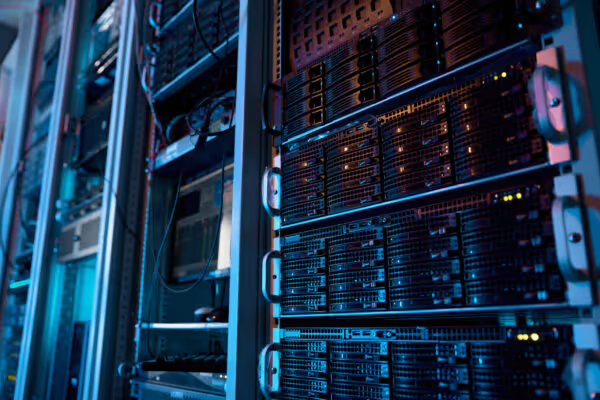




The rapid proliferation of data centers, driven by AI and cloud computing advancements, presents significant opportunities and complex challenges for water utilities. These facilities often consume millions of gallons of water daily and can strain existing resources and infrastructure, necessitating thoughtful and equitable pricing strategies for water. This article explores various approaches utilities can consider for cost recovery, while promoting sustainability and fostering mutually beneficial relationships with these massive water users.
Data centers are exceptionally "thirsty" due to their continuous cooling requirements, which dissipate the substantial heat generated by their servers. While some facilities might have relatively uniform water usage, others exhibit significant peaking factors, with water use tending to spike during warmer months as cooling systems work harder. A single data center can consume as much as one to five million gallons of water per day, equivalent to the daily consumption of a town of 10,000 to 50,000 people. The primary water consumption comes from cooling systems, predominantly evaporative cooling, which is water-intensive. While some data centers are exploring alternative cooling methods and water reuse, the overall demand is projected to continue increasing substantially for the foreseeable future.

Utilities must balance the economic benefits data centers can bring, such as tax revenue and job creation, with the potential strain on water resources and infrastructure. Critical considerations include:
[[CTA:subscribe]]
To address these considerations, utilities have several cost-recovery tools at their disposal, such as system development fees, up-front capital contributions, and customized rate structures.
System development charges, sometimes referred to as capacity or impact fees, are one-time fees paid by new or expanding customers to recover a fair share of the capacity cost in the existing or future facilities. These charges are typically based on a customer’s expected peak demand and are designed to ensure that growth helps pay for the infrastructure needed to support it.
Data centers often require substantial new infrastructure—transmission mains, storage tanks, pump stations, or treatment plant upgrades—to connect to the system. These costs are frequently site-specific, meaning they wouldn’t arise “but for” the data center project. One cost recovery strategy is to require the data center customer to fund the up-front capital project costs directly or through a reimbursement agreement.
When this happens, should you still charge an SDC?
In many cases, a data center’s contribution to this site-specific investment does not eliminate its use of shared system capacity—such as water treatment, wastewater interceptors, or regional storage. Even when customers fund 100% of the infrastructure needed to connect, they often use and benefit from the broader system capacity.
In these cases, charging an SDC may still be appropriate. The right approach will vary depending on local SDC methodologies and system characteristics, so long as the assessment policies are flexible enough to accommodate the unique situation.
Unlike typical residential or commercial customers, data centers can expand rapidly, scale back operations, or change their demand profile significantly over time. This volatility creates a risk for utilities trying to match infrastructure investment with future revenue.
To manage this risk, utilities may want to assess SDCs for large, unique customers based on engineering estimates of actual peak demand—rather than relying on standardized methods like meter size or equivalent residential units (ERUs).
Some best practices include:
This approach gives utilities a better toolset to match infrastructure investment with actual usage while ensuring fairness across customer classes.
Once a data center connects to the water utility system and becomes operational, how should data centers be charged on an ongoing basis?
There’s no one-size-fits-all answer. Utilities should consider factors like infrastructure cost drivers and the broader pricing philosophy used across their customer classes.
Data centers are long-term but dynamic customers. Their demand profile can change substantially, especially as new technologies and cooling methods emerge. Utilities can reduce risk and improve fairness by incorporating periodic reassessments into their pricing frameworks.
Options include:
These strategies help utilities adjust course when initial assumptions don’t hold—protecting system integrity and rate equity.
The strategies described above can be implemented in a variety of ways:
Formalizing these mechanisms in advance provides predictability for both the utility and the customer, especially for high-profile projects with significant capital implications.
Serving data centers presents both an opportunity and a challenge. With the right tools—flexible SDC frameworks, thoughtful rate structures, and proactive reassessment—utilities can recover their costs fairly while supporting economic growth. While there’s no universal pricing formula, building pricing structures that reflect actual usage, system impacts, and long-term risk can position utilities for sustainable success.
Raftelis works with communities nationwide to design pricing frameworks that balance growth, equity, and cost recovery. Contact Delaney Ridgley or John Mastracchio to discuss how your utility can prepare for large-scale customers like data centers.
Link copied