7
minute read



The numbers tell a stark story. A year-end 2025 national poll by Pew Research found that public trust in government has dropped to near the lowest point in nearly 70 years of tracking, with just 17% of Americans saying they trust the government most or all of the time, down from 73% when the question was first asked in 1958.
Just 2% of Americans say they trust the government “just about always,” and only 15% say “most of the time,” for a combined total of 17%.
For those who lead organizations, the stakes are concrete. Trust is the currency that lets a community pass a sales tax referendum, adopt a necessary rate increase, secure compliance with a public health order, or extend patience during a service disruption.
When trust is high, governing across every department is easier. When it is low, even sound policy meets resistance, and the cost of that resistance shows up in failed ballot measures, stalled projects, and the slow erosion of an organization’s ability to serve. Communication is how that trust is earned or lost, message by message and interaction by interaction.
There is a critical nuance, however. The public draws a distinction between government as an institution and the people who work within it. Research from the Partnership for Public Service found that 46% of Americans trust civil servants, 50% believe most are committed to helping people, and 55% think civil servants are competent. This gap between institutional distrust and individual trust offers leaders and communicators a real opportunity to bridge it by centering the voices of frontline staff.
When we examine the research on institutional trust, four interconnected signals emerge that shape whether people believe an organization deserves their confidence. Humanity is the signal that an organization cares about its people, not just its processes. Transparency is the willingness to share information openly, including when the news is unfavorable or incomplete: 58% of young adults rank transparency and honesty among their top three qualities for trustworthiness. Capability is the demonstration that an organization can deliver on its promises, shown through data, progress updates, and honest assessments of shortcomings. Reliability is the consistency of follow-through over time, the difference between a one-time transparency effort and a sustained communication practice.
Together, these four signals provide a practical diagnostic framework for leaders and communications teams alike. When trust erodes, at least one of these signals has broken down. The scenarios that follow illustrate how.
Consider a mid-sized city where residents begin reporting problems with their drinking water: discoloration, odor, and skin irritation. Initial complaints trickle in through 311 calls and social media. The utility, working with limited information and awaiting test results, chooses not to issue a public statement, reasoning that speaking prematurely could cause unnecessary alarm.
As weeks pass, complaints multiply. Journalists begin asking questions. Community groups organize. The official response remains muted: a brief statement that the water meets regulatory standards, without acknowledging the lived experience of residents who can see and smell that something is wrong. By the time leadership issues a full public response, the narrative has already been set. The community does not see a government working carefully through a complex issue. They see a government that knew something was wrong and chose not to tell them.
The damage compounds because residents who feel dismissed lose confidence not only in this specific issue, but in the agency’s willingness to be honest about future problems. Even after infrastructure investment and independent verification that the water is safe, many residents refuse to trust the tap water.
The lesson is direct: silence is not a neutral act. The window between “we do not have all the answers yet” and “they are covering this up” is shorter than most organizations realize.
[[CTA:subscribe]]
A major natural disaster strikes a region, and a government agency mobilizes response operations. Teams are on the ground within hours, standing up shelters and processing assistance applications. The operational response is solid. But within days, misinformation about the response begins spreading faster than the facts.
Social media posts claim the agency is withholding aid. Viral videos taken out of context suggest that responders are turning people away. Prominent public figures amplify the claims, and residents, already stressed and displaced, begin questioning whether seeking assistance is worth the effort. Some stop showing up at distribution centers. Others refuse to register for programs they are entitled to.
The agency responds with a dedicated rumor-response page and expands direct outreach through text messages and community channels. These are smart tactical moves, but they are playing catch-up in a fundamentally changed communication environment.
This scenario reveals a critical reality: organizations can no longer assume that providing accurate information means the public will receive it. The traditional playbook of press releases and official briefings is insufficient when falsehoods travel faster than facts. Communicators must plan to reach people in a contested information space and do so proactively, before misinformation takes root.
A local redevelopment agency has been defined by scandal under prior leadership: mismanagement, questionable spending, and a lack of transparency. A new team takes over but faces a community that has largely written the agency off. Public meetings draw sparse attendance. Media coverage defaults to past failures.
Rather than playing defense against old criticism, the new team develops proactive messaging centered on the agency’s core impact: affordable housing, historic preservation, and community investment. They feature the voices of residents and small business owners directly benefiting from the work. They publish measurable outcomes and invite community members into the planning process.
Over time, the narrative shifts. Media coverage reflects current work rather than past failures. Community meeting attendance grows. Residents who once dismissed the agency begin engaging with programs and sharing positive experiences.
Trust recovery is possible, but it requires sustained effort and a fundamentally different posture than that of a crisis response. The agency did not try to "win back" trust through a single campaign. It is committed to a long-term communication approach built on community voice, measurable outcomes, and consistent engagement.
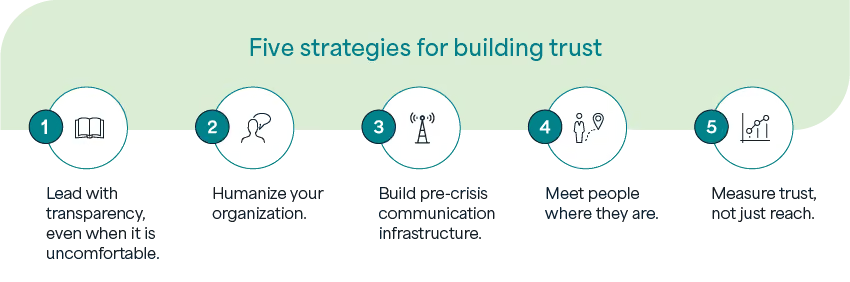
1. Lead with transparency, even when it is uncomfortable. Organizations that acknowledge challenges openly and communicate proactively build more credibility than those that wait for a complete picture. Transparency does not require perfection. It requires honesty.
2. Humanize your organization. People trust civil servants more than they trust institutions. Feature frontline employees in communications. Share community stories. Replace institutional language with human language.
3. Build pre-crisis communication infrastructure. Both the silence and misinformation scenarios demonstrate that the time to build trust is before a crisis hits. Waiting until a crisis to build communication systems is like buying insurance after the accident.
4. Meet people where they are. A press release that reaches no one builds no trust. Understanding your community’s information habits is a prerequisite for effective engagement.
5. Measure trust, not just reach. Most teams measure outputs such as impressions, website traffic, and press releases issued. These metrics tell you how far your message traveled, but nothing about whether anyone believed it.
For city managers and executive leadership, trust is not solely a communications function to be delegated. Three commitments distinguish organizations that treat trust as a leadership priority. First, leaders resource the communications function as a strategic capability rather than a press-release service, giving communicators a seat at the table when decisions are made, not after. Second, they model transparency from the top, because a communications team cannot be more open than the leadership it represents. Third, they connect communication goals to organizational outcomes, recognizing that the ability to pass a ballot measure or sustain a capital program depends on the public trust built in the years before the vote, not in the weeks before it.
Trust is rebuilt through sustained, intentional effort. It requires transparency even when transparency is uncomfortable. It requires centering the voices of the communities your organization serves. It requires building infrastructure before you need it, meeting people where they are, and measuring what actually matters.
The leaders and communicators who commit to this work will not see overnight results. But they will build something more durable than any single message or campaign: a relationship with their community grounded in credibility, clarity, and mutual respect.
Trust is not a campaign. It is a practice.
For more information on how your local government or utility can build community trust, contact Nick Zoller at nzoller@raftelis.com.
Link copied