7
minute read




At a recent interactive work session with a Florida city, the mayor leaned forward as we toggled through three different revenue recovery scenarios on screen. "So, you're telling me," he said, "that without some combination of these changes, we're insolvent by 2030?" The answer was: functionally, yes. But the more important answer was what came next: here is what you can do about it, here is what each option costs your taxpayers, and here is how you explain it to the stakeholders.
That is the conversation Florida municipalities need to have right now. Very few have the tools to have it well. And while the immediate urgency belongs to Florida, the underlying challenge of making fiscal decisions under structural uncertainty and communicating them transparently to stakeholders is one that local governments everywhere face every budget cycle.
Florida's proposed constitutional amendment, CS/HJR 1F, if approved by voters in November 2026, would take legal effect January 1, 2027. Under the proposal, the homestead exemption would rise from $50,000 to $150,000, with that change first reflected in tax bills mailed to property owners in November 2027 and hitting municipal budgets in FY2027-28. A second increase to $250,000 would follow in FY2028-29. The amendment would also reduce the annual assessed value growth cap on non-homestead properties from 10% to 5%. The fiscal impact on municipalities that depend heavily on ad valorem tax revenue would be immediate and compounding.
For a typical Florida city, ad valorem taxes represent anywhere from 30% to 60% of general fund revenues. A sudden reduction in taxable value does not simply create a one-year budget gap. It reshapes the entire fiscal trajectory. Reserve funds that took a decade to build after the financial collapse of 2008 can be depleted within the next three to four years without mitigation strategies. Capital projects get deferred, staffing levels come under pressure, and service delivery standards quietly erode, often before governing bodies fully grasp the scope of what is happening.
It is worth stating plainly: the referendummay not pass. But that outcome should not be a reason to delay planning. Property tax revenues are vulnerable well beyond a constitutional amendment. Economic downturns compress assessed values across entire markets, as Florida municipalities learned painfully after 2008. Growth that has sustained rising tax rolls for years can slow or plateau, removing the cushion that masks structural imbalances. Municipalities that have worked through the CS/HJR 1F scenarios with us have consistently discovered secondary vulnerabilities in their long-range projections that exist independent of any tax reform: structural expenditure growth, underperforming revenue assumptions, or reserve targets that look achievable on paper but are fragile under stress. The reform serves as a forcing function for a planning conversation that has durable value regardless of the November vote.
The challenge is compounded by the communication dimension. Elected officials and city managers are accountable not just for making sound fiscal decisions, but for explaining those decisions to taxpayers who may simultaneously welcome a lower property tax bill while facing reductions in the services that result if the referendum passes. The politics are delicate. The math is unforgiving.
Raftelis developed its facilitated General Fund Financial Sustainability Modeling process to help municipalities confront exactly this kind of structural uncertainty. The model process works in two phases: impact simulation and solution evaluation.
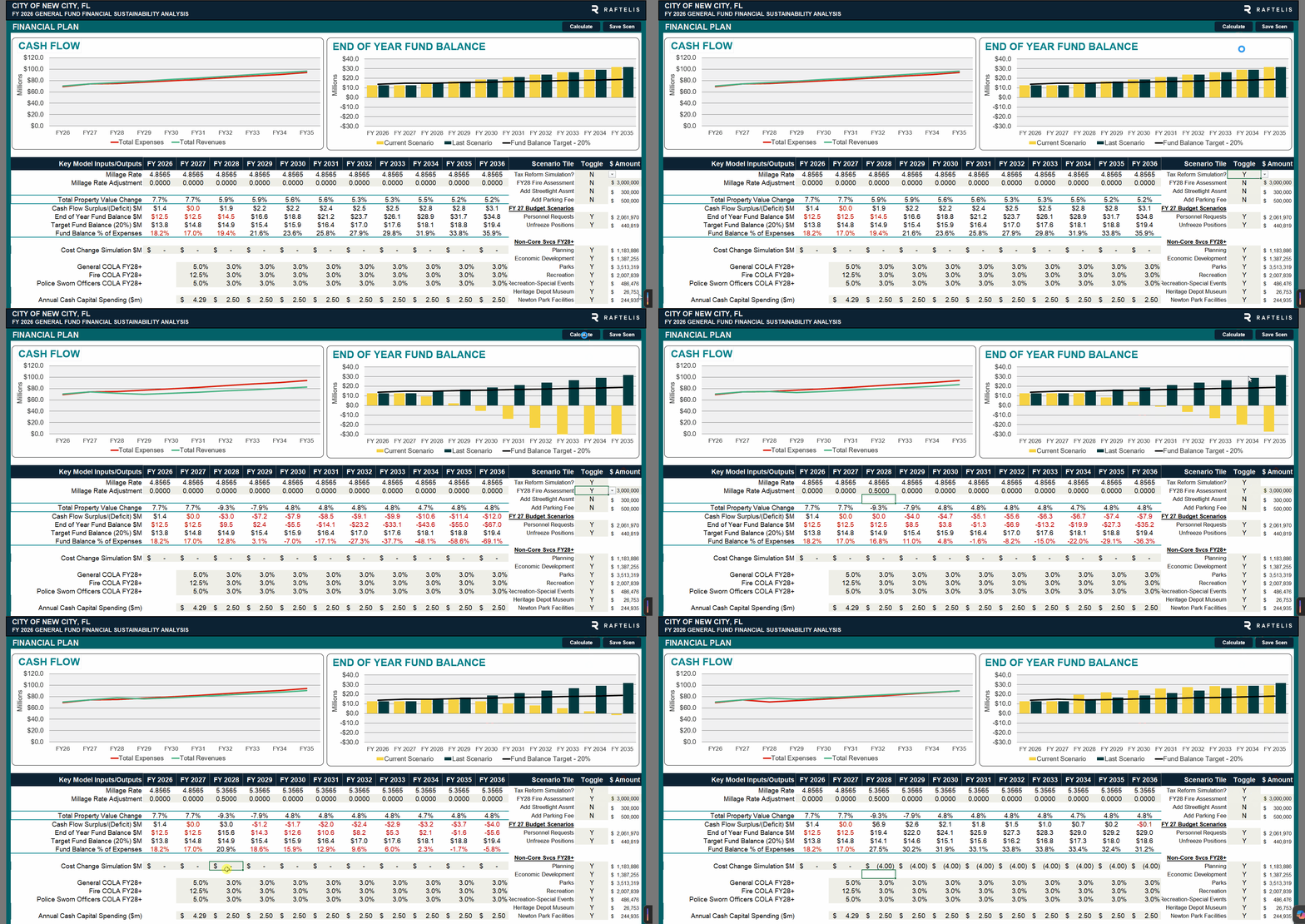
The first step is translating the legislative language of CS/HJR 1F into parcel-level fiscal reality. Using the municipality's actual property roll data, the model applies exemption thresholds at the individual parcel level rather than relying on aggregate estimates. This distinction matters. A blanket percentage reduction in taxable value misses the uneven distribution of exemption benefits across property types and assessed value ranges. Parcel-level modeling captures which homeowners lose all taxable value under the new thresholds, which non-residential properties are affected by the tightened assessment cap, and how the jurisdiction's millage yield shifts year by year as inflationary indexing takes hold.
The output is immediate and visual: a 10-year cash flow projection showing revenues against expenditures, overlaid on a fund balance chart with the city's target reserve threshold clearly marked. Decision-makers see graphically not just a dollar gap, but the specific year in which the fund balance crosses below the policy floor.
The model's real power is in the solution layer. Once the baseline impact is established, the platform becomes a live decision support tool. In work sessions with Staff and elected officials we can toggle individual levers in real time and watch the 10-year projection respond:
Each scenario also produces a property-level bill impact summary. This is not a secondary feature. It is the communication bridge between fiscal policy and community understanding. When a municipal client can show a constituent exactly what a proposed adjustment means for their specific property type, the conversation moves from abstract to concrete.
The financial modeling process also frequently surfaces structural questions that go beyond revenue and reserves. When the analysis reveals that expenditure growth is outpacing service delivery value, or that an organization's cost structure no longer reflects its operating realities, Raftelis brings complementary capabilities to bear. Our fee and assessment design services help municipalities design and implement legally sound alternative revenue structures. Our operational efficiency and organizational assessment practice helps leadership teams identify wherere structuring, consolidation, or process improvement can reduce cost without degrading service. The modeling platform is the starting point for that broader conversation.
[[CTA:subscribe]]
This kind of facilitated decision support modeling is not only valuable in the context of Florida's tax reform. Any local government, in any state, faces layers of fiscal decisions that are difficult to evaluate in isolation and harder to explain. Whether the pressure comes from a structural revenue shift, rising pension obligations, an aging infrastructure backlog, or a service expansion request from the community, the core challenge is the same: how do you model the long-term consequences of today's choices, weigh alternatives honestly, and bring stakeholders along?
Raftelis's dynamic modeling process is built to facilitate the discussion and answer that question for any municipal fund that needs to be managed across a multi-year horizon. The Florida tax reform scenario is a compelling and urgent application. It is not the only one.
For Florida municipalities specifically, the goal is a governing body and a community that understand what is at stake, what the realistic options are and the consequences of each, and what the trade-offs look like before a budget crisis arrives rather than during it.
Municipalities that invest now in rigorous, transparent fiscal scenario planning will be better positioned to adopt long-range sustainable budgets, communicate proactively with taxpayers and elected officials, maintain service levels through a revenue transition rather than reacting with across-the-board cuts, and build the community trust that comes from demonstrable transparency.
Property tax reform, if passed, will not respect the boundaries of a single budget cycle. Its effects will compound for years. The municipalities that navigate it best will not be the ones that waited for the final vote count. They will be the ones that modeled the outcomes, tested the solutions, and entered the conversation with a clear-eyed plan.
Raftelis is proud to partner with Florida local governments navigating this challenge, and with local governments everywhere that are committed to long-term fiscal transparency.
To discuss how Raftelis can support your community's planning, reach out directly to our team: Thierry Boveri at tboveri@raftelis.com, Bart Kreps at bkreps@raftelis.com, and Erick van Malssen at evanmalssen@raftelis.com
Link copied