6
minute read






Mid-level managers serve as the essential bridge between an organization’s executive vision and the realities of frontline execution. They translate strategy into action, align teams, and drive results. In local government and utility environments, this role is uniquely complex. Managers navigate competing demands from executive leadership while supporting staff through the daily pressures of service delivery. As the workforce undergoes a generational shift, there is increasing pressure to draw senior-level leaders from this specific group.
Most local governments and public utilities recognize the need for “succession planning.” However, beyond tracking the retirement eligibility dates of key employees, few have developed concrete action plans to prepare for current and future retirements. This is hitting middle management hard, as both middle and senior leaders are retiring at the same time. There is more need for them to advance to senior leadership. Mission Square Research Institute conducts annual workforce surveys and found that most state and local governments have not addressed the need for succession planning (only 16% noted they have addressed this based on their 2024 survey).
Furthermore, the institute identified succession planning as one of the top six workforce trends for 2025. The report went on to state, “Planning for succession does not mean handpicking deputies who will step into department head or other key roles years ahead of time. It may, in fact, involve preparing a larger cohort of multiple qualified staff who are given access to professional development, cross-departmental teams with leadership opportunities, job rotations, mentoring, and other support. This helps ensure that even if a single mid-level manager were to leave unexpectedly, the organization would have sufficient bench strength to consider multiple candidates when the key leadership roles become vacant.”
Failing to support mid-level managers creates significant operational and strategic risks for an organization. Without this type of support, supervisors often absorb the impact of resource constraints and complex operational changes, which accelerates burnout. Without adequate training and peer support, managers may leave the organization, taking valuable institutional knowledge with them.
Some of the other support can include coaching, short-term assignments, and cross -departmental leadership opportunities. These are not high-cost items, and when part of an overall professional development plan, can really make a difference. Raftelis assists organizations with senior leadership executive recruitment and increasingly is being asked to help find mid-level managers. We can help you find mid-level managers, but we also want to help you build your own bench.
These challenges are common across the country. As an example, the experience of one mid-sized Virginia community confirms that the transition from technical expert to people leader is a universal challenge across multiple management tiers, and leadership is taking proactive steps to bridge this gap. Because these leaders serve as the vital link between executive vision and frontline execution, neglecting their development disrupts communication and stalls strategic initiatives. Without adequate training, clear performance metrics, and peer support, managers quickly face burnout and leave the organization, taking valuable institutional knowledge with them. This instability directly impacts frontline staff, as unsupported supervisors struggle to foster engagement, manage performance, and retain their teams. Ultimately, underinvesting in the middle management tier compromises immediate service delivery and weakens the succession pipeline required for future leadership.
Although some organizations build the internal capacity to address them, many partner with our experts to successfully navigate these complexities. In that same Virginia community, their experience confirms that the transition from technical expert to people leader is a universal challenge across multiple management tiers, and they are taking proactive steps to bridge this gap.
Their Human Resources Director said, "We found that across the board—from crew supervisors to deputy directors—our leaders were straddling the line between technical expertise and effective leadership. Many highly capable people simply didn't have the basic tools for risk management, legal compliance, talent performance, finance, and budget. That is why we are investing in a dedicated Learning and Development function to provide the foundational skills they need to succeed as people leaders."
In addition to the practical skills mentioned above, key training for these middle managers includes leadership skills. The need for greater skills in strategic communication, negotiation, conflict resolution, and collaboration (internally and externally) is key to success in senior leadership positions. Starting to instill this in middle managers is an excellent way to build your bench and strengthen the organization.
If organizations are serious about strengthening their leadership pipeline, they must focus on the conditions that shape mid-level managers’ daily experience. First, organizations must address workload and capacity through thoughtful demand forecasting, ensuring managers are not overwhelmed by the dual pressures of daily operations and special projects. Equally important is fostering empowerment and autonomy. Mid-level leaders are most effective when trusted to make program-level decisions without excessive reliance on executive approval for routine matters. This not only improves responsiveness and efficiency but also strengthens accountability, encourages ownership, and builds leadership confidence. Small decisions made help build the skill and confidence for larger decisions as your employees progress through your organization and in their careers.
[[CTA:subscribe]]
Finally, a clear, transparent career path is essential. Organizations should define what success looks like in these roles and articulate the specific competencies, experiences, and milestones required to advance to executive leadership. For example, organizations can implement strategies such as structured leadership development programs, targeted stretch assignments, and cross-functional project opportunities that broaden exposure and build critical skills. Establishing formal mentorship programs, providing leadership coaches, conducting regular career development conversations, and creating clear succession and growth plans can further strengthen the internal talent pipeline. Additionally, recognizing and rewarding performance, while ensuring managers have the tools, resources, and support they need to succeed, reinforces engagement and long-term retention. When managers can see a future within the organization and understand how to get there, they are more likely to remain engaged, motivated, and committed.
When the director of Johnson City's Water and Sewer Services Department announced his retirement, the organization faced a challenge familiar to many utilities: a long-tenured leader was stepping away, and the incoming director would need to earn the trust and confidence of an established management team—quickly.
Rather than leaving that relationship-building to chance, Johnson City made a deliberate investment. Working with the Raftelis Performance Academy, the department brought its supervisors, managers, and department leaders together through the Process Improvement and Innovation program—with incoming Director Jon Lane participating alongside his new team. The curriculum, rooted in Lean and Six Sigma principles and tailored to local government and utility contexts, provided participants with hands-on practice with tools such as root cause analysis, process mapping, and structured problem-solving frameworks. But the most valuable outcome wasn't a single tool or technique. It was the experience of working through real challenges together—across divisions and across levels of the organization.
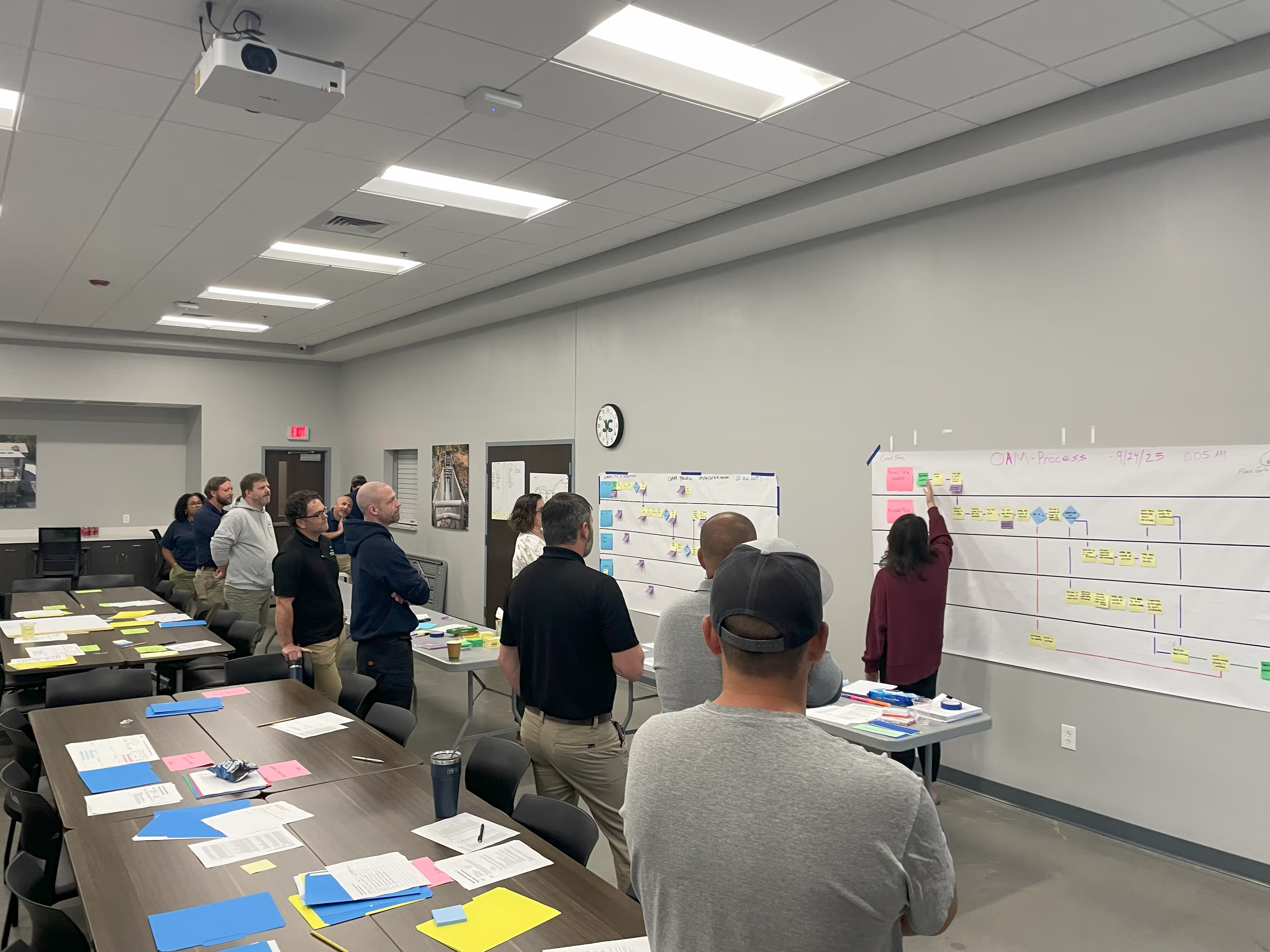
By the time the program concluded, Jon and his management team had something that no org chart or onboarding checklist could provide: a shared language, a shared framework, and a foundation of genuine connection built around solving problems together.
Mid-level managers are the operational core of local governments and public utilities. As the workforce ages and service demands increase, relying on passive succession planning is a risk organizations can no longer afford. By actively investing in the middle management tier through targeted leadership training, balanced workloads, and empowered decision-making, agencies can reduce burnout and retain vital institutional knowledge. Preparing a broad cohort of capable leaders, rather than simply identifying single replacements, ensures continuity of service. Ultimately, empowering mid-level managers is not just a retention strategy; it is a critical investment in your organization’s long-term resilience and success.
Whether you are facing challenges in attracting executive leaders, retaining mid-level managers, or developing your internal talent pipeline, Raftelis can support your organization. Through a combination of executive recruitment, leadership coaching, organizational assessment, and strategic advisory services, Raftelis partners with public agencies to build strong leadership teams, strengthen workplace culture, and position organizations for long-term success.
If you need assistance, Raftelis can provide leadership coaching, customized training for mid-level managers and new leaders, and help build your bench. Contact Catherine Tuck Parrish at ctuckparrish@raftelis.com for more information.
Link copied