minute read





So, what are the practical steps you can take to manage, implement, and update your adopted strategic plan?
This is the third in a series of Think Tank articles on strategic planning. The first was on launching and celebrating your strategic plan. The second was about the management structure needed to move from having only a plan to achieving elevated performance.
As discussed in the previous article, it starts with assigning overall management. This central point of coordination ensures that progress is tracked and all resources – human, financial, organizational, etc. – move in the right direction. Having a central coordination point also prevents 'siloing.' While department heads own the deliverables, the central coordinator owns the progress of the plan—ensuring deadlines are met, and reporting remains consistent.
But having good overall management doesn’t help if there’s not a solid implementation plan, which is where the real work gets done. A strategic plan contains goals and objectives, and yet for it to be real for the organization, specific strategies or initiatives must be tied to the plan. An implementation plan provides the structure for identifying:
A meaningful implementation plan connects the strategic plan to the organization. Each person in the organization should be able to see themselves in the plan in one way or another, which helps the strategic plan become part of “how we work” rather than an add-on task.
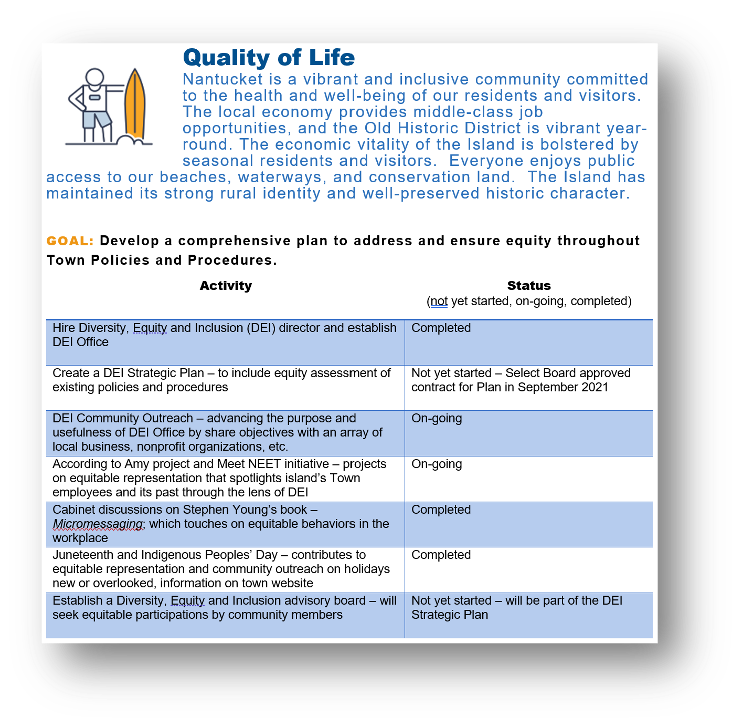
If strategic planning is new to an organization, we suggest that the implementation plan begin small, using a simple tool or template that is easy for staff to adopt. It might be as simple as an Excel spreadsheet or a Word document for internal tracking. It can live on the organization’s shared drive so that each person designated as the lead for an element of the implementation plan can go into the same document to provide updates.
There may also be a need for an externally facing progress report on the strategic plan. Again, this should be kept simple if it is new to the organization. Some organizations report on only a few high-priority projects. For instance, the City of Newark, CA, has selected five major capital projects to report on. An example of an agency that reports on all projects within its strategic plan, using a Word document on its website, is the City of Emeryville, CA. In time, reporting could evolve to be a more robust performance dashboard. Examples are the City of Elk Grove, CA, and the City of Sunnyvale, CA.
Initial work on the implementation plan should be with the agency’s leadership team to determine what that group is comfortable with. Once leadership has a template and base starting point, tracking, monitoring, and reporting can build from there.
[[CTA:subscribe]]
Strategic plans typically span three to five years, providing a stable vision that prevents reactive policy shifts. However, implementation planning is dynamic and ideally aligns with the organization’s budgeting cycle. Think of the plan as a compass: the destination stays the same, but the path should be refreshed annually to stay aligned with current conditions and available resources.
For example, the Sewerage and Water Board of New Orleans hosts an annual planning session where the previous year’s progress is reviewed and the next year’s implementation plans are developed. Strategic plan progress is housed in the Ellio Performance platform.

As you reach the end of a plan cycle, your tracking data becomes your roadmap for the future. It clearly identifies what has been achieved and what critical work moves forward into the next cycle.
To maintain momentum, start the formal update process at least three months before the current plan expires. Depending on the plan’s focus, this update may involve the leadership team, the governing body, staff, and/or public stakeholders. The goal is a seamless transition that avoids a "planning gap." This continuity reinforces strategic thinking not as a periodic project, but as a permanent habit—building it directly into the "way we do business."
Finally, remember that strategic planning can be hard work. Don’t wait until the end of a five-year cycle to acknowledge success. Celebrate small wins along the way to build morale and demonstrate to stakeholders that their vision is being turned into reality.
For more information on turning your strategic plan into a reality, contact Nancy Hetrick at nhetrick@raftelis.com or Jan Perkins at jperkins@raftelis.com.
Link copied